Team of Abdou Rachid Thiam · Laboratoire de Physique de l'ENS, Paris
We explore how lipids and physical forces organize cellular membranes, shape organelles, and regulate their functions.
Research
We combine cell biology, biophysics and soft-matter physics: we study organelles in living cells, and we rebuild them in vitro to measure the forces and lipid properties that control them.
Organelle biology
How do lipids build and organize organelles?
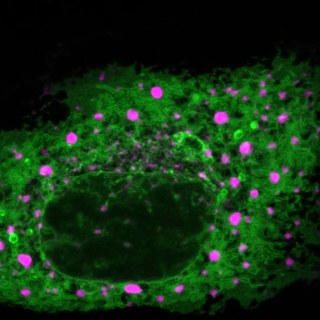
Organelles are built from lipids, and their lipid composition sets their shape, size and identity. Using the ER and lipid droplets as main models, we study how neutral lipids gather between the ER leaflets, how droplets bud and grow, and how seipin guides these steps. We extend these questions to mitochondria, lysosomes and the contact sites that link organelles.
How do proteins sense and reshape lipid environments, and vice versa?
Proteins read lipid packing, composition and tension to decide where to bind; once bound, they remodel the membrane and the lipids it stores. We study this two-way dialogue with perilipins, amphipathic helices, ER membrane proteins, lipid transfer proteins such as ATG2, and the autophagy protein LC3.
perilipins · amphipathic helices · lipid transfer · autophagy
Membrane mechanics
How do physical forces control organelle behavior?
Membranes are soft materials: tension, curvature and lipid packing decide how organelles deform, bud and fuse. We measure these forces directly on model membranes and on giant vesicles made from organelles, and connect them to organelle behavior in cells.
tension · curvature · giant organelle vesicles
Emulsion and microfluidics
Can we rebuild organelles to uncover the physics of life?
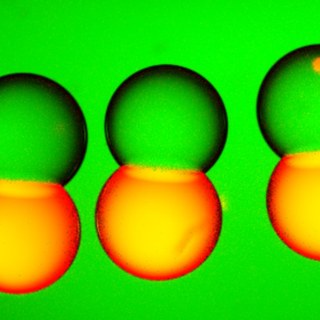
We come from emulsion physics. Droplet-embedded vesicles, artificial lipid droplets and droplet interface bilayers made in microfluidic chips let us rebuild organelle membranes with the composition we choose, and test which physical rules cells rely on.
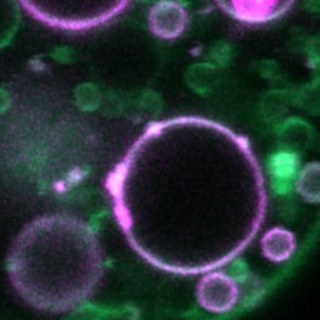
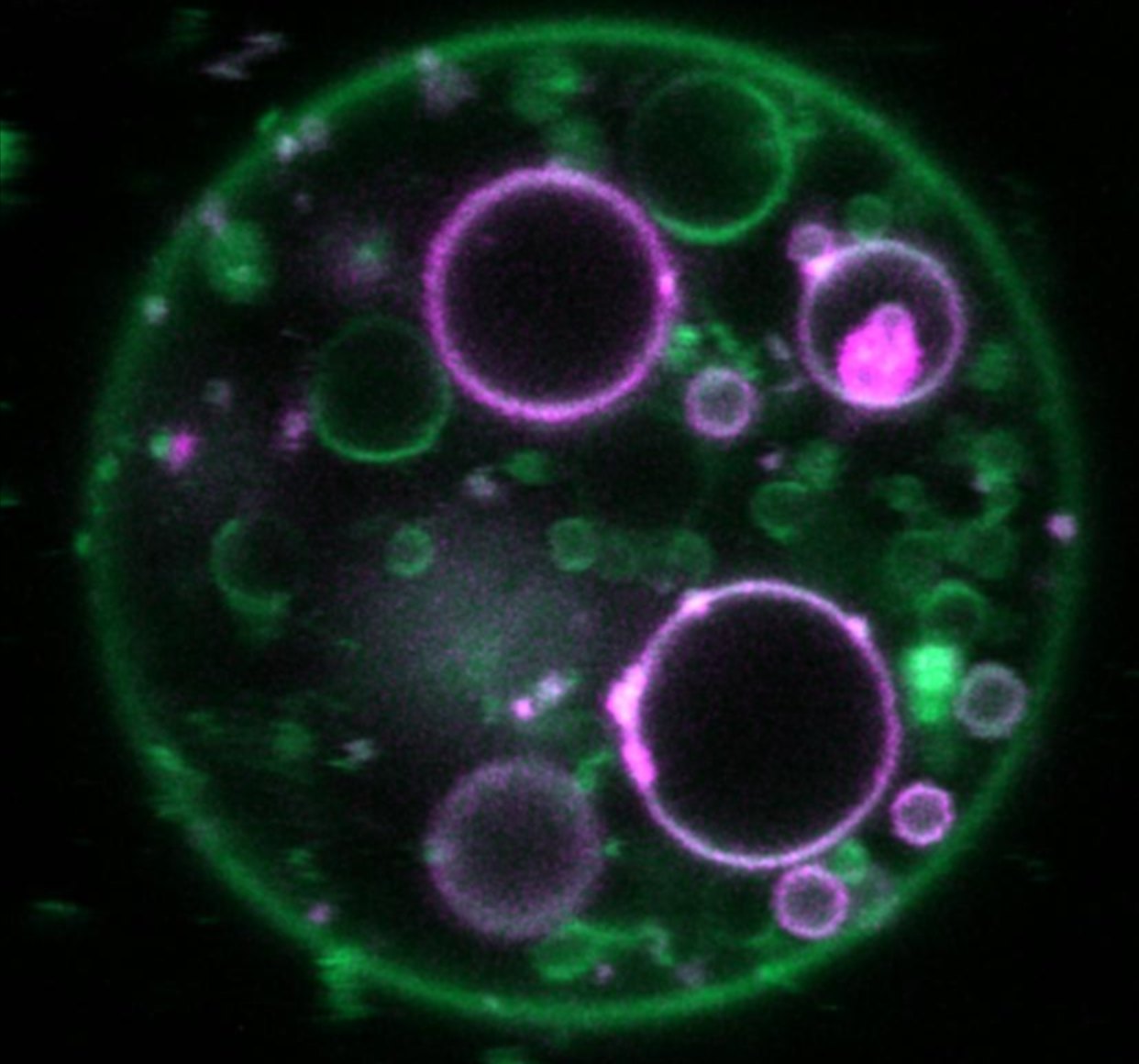
We transform native cellular organelles into giant, experimentally accessible membrane systems. By preserving key features of their biological composition while enabling direct physical manipulation, these platforms allow us to measure membrane mechanics, investigate protein function, and reconstruct cellular processes under controlled conditions.
Approaches
Live-cell imagingConfocal and live microscopy of organelles, lipid droplets and contact sites in cultured cells.
Cell biologyGene silencing, knockouts and tagged proteins to perturb lipid metabolism and follow its effects.
In vitro reconstitutionArtificial lipid droplets, droplet-embedded vesicles and giant vesicles with a lipid composition we control.
Giant organelle vesiclesNative organelles turned into giant membranes for direct physical and biochemical tests.
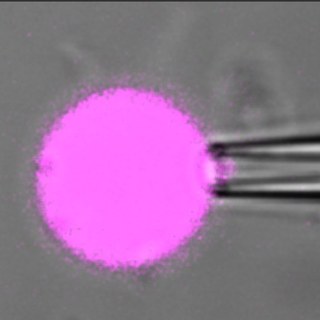
MicromanipulationMicropipettes to measure membrane tension and mechanics, and to pull membrane tubes.
Microfluidics & emulsionsDroplet interface bilayers and microfluidic chips to probe permeability and protein binding.
With our collaborators: lipidomics, structural biology and molecular dynamics simulations.
People
Current team
Alumni
Gallery
Join us & contact
We welcome physicists, chemists and biologists for internships, PhDs and postdocs. Send a CV and a few lines on what interests you.
Laboratoire de Physique de l'ENS 24 rue Lhomond, 75005 Paris
art@ens.fr
Publications
Selected
2026Tripartite ER–mitochondria–lipid droplets contact sites control adipocyte metabolic flexibilityPalard et al., The EMBO Journal
2025ATG2A-mediated DAG transfer recruits DGAT2 for lipid droplet growthElhan et al., Nature Structural & Molecular Biology
2025Seipin governs caveolin-1 trafficking through modulating sphingolipid–glycerolipid balanceCarpentier et al., Cell Reports
2024Giant organelle vesicles to uncover intracellular membrane mechanics and plasticitySantinho et al., Nature Communications
2023Cholesterol esters form supercooled lipid droplets whose nucleation is facilitated by triacylglycerolsDumesnil et al., Nature Communications